Performance
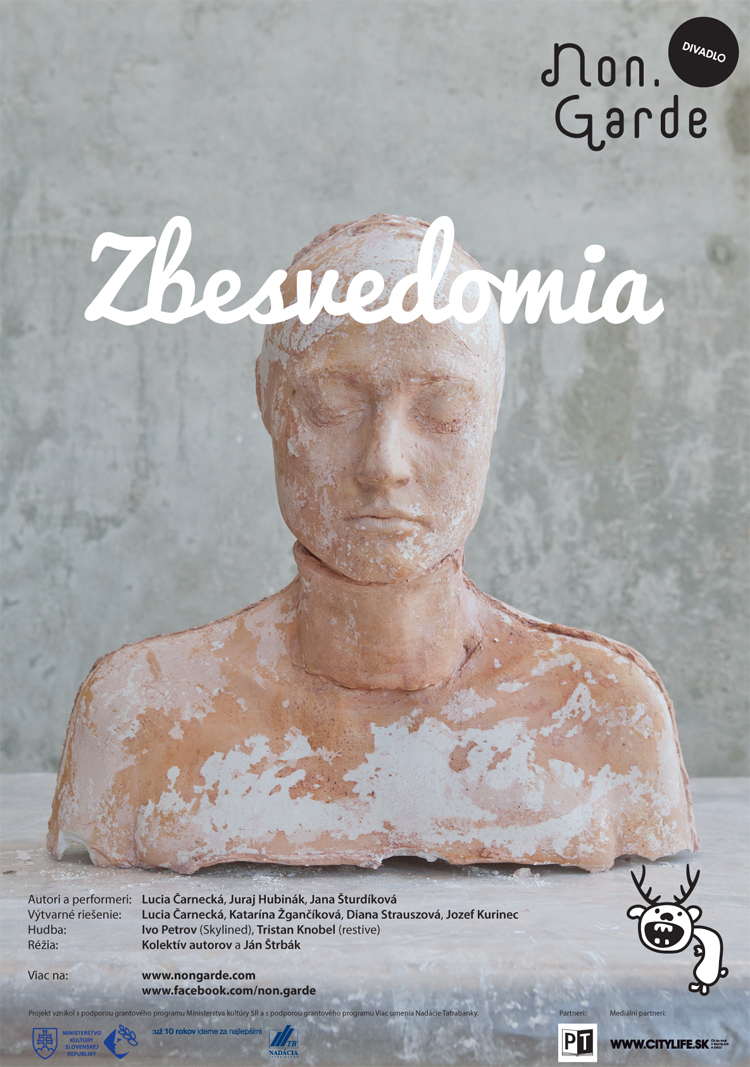
Zbesvedomia is an original story about the human inner world, ‘modeled’ into an artistic form on the border between theatre and visual art. It combines a non-classical approach to production with traditional sculptural techniques. The creators of the Non.Garde Theatre explore consciousness, the subconscious, and the unconscious, seeking their source of power, mutual intersections, relationships, and what they influence. At the same time, they answer the question of what it is like to be both the object and the subject of one’s own form, where the boundary between ‘perceiving’ and ‘being perceived’ lies, and what role time plays in these relationships.
Authors and performers: Lucia Čarnecká, Juraj Hubinák, Jana Šturdíková
Art design: Lucia Čarnecká, Katarína Žgančíková, Diana Strauszová, Jozef Kurinec
Music: Ivo Petrov (Skylined), Tristan Knobel (restive)
Direction: Collective of authors and Ján Štrbák
Trailer: Miroslav Hlpka
Photo: Peter Korček
Poster: Lucia Pelikantová
Renewed premiere: July 22, 2014


Feedback:
Zbesvedomia – A World Where One Simply Exists
Consciousness, the awareness of life, conscience – a few attributes that animate human matter and give the human body a spiritual dimension. Thinking and thoughts, which allow us to make decisions, dream, and remember, circulate in the brain and move the motor system. They give us the feeling that whatever walks within me, whatever breathes, whatever feels, that is me. Words and impulses emanating from the body create a strange poetic image, fluid and incomprehensible. Outside of space and time – much like the Non.Garde Theatre itself.
For several years, the Non.Garde Theatre has been working with its distinctive poetics, moving on the border between theatricalized visual performance and installation, with a strong creative input from performers Lucia Čarnecká, Jana Šturdíková, and Juraj Hubinák. In their latest work, Zbesvedomia, the creators drew inspiration from the human brain, its processes, and transformations. They explore human subjectivity, attempt to materialize thought processes, and, within a strong visual concept, animate the matter of a sculpture only to immobilize it a moment later. In doing so, they create an unconventional laboratory that terrifies, surprises, ironizes, and, above all, provides space for the audience’s perception. In this environment, the viewer can come to realize what it actually means to remain conscious.
Similar to their previous work, Various Chapters of the Same Book (2012), the performers bring their distinctive expression into the concept, moving stylistically through the space to occupy new, meaning-making, and defining spatial configurations.
The creators chose the bust as the primary artistic element, allowing us to see its creation, existence, and demise within the space. We witness the meticulous process of making a bust, in which the human likeness remains captured forever. The authors thus connect the inanimate world with the living one.
Furthermore, they explore the workings of the human brain and the creation of thoughts and thinking. The wordplay in the title itself can hide conscience (svedomie), consciousness (vedomie), or its absence (bezvedomie). What matters is the realization of the fact that what we have inside us is more permanent than a single moment. That what takes place inside the human body is not just a chemical process, but something alive and sensitive, with its own form of existence in dreams, thoughts, and emotions.
At the beginning, Juraj Hubinák, dressed in a master of ceremonies’ white tailcoat, ceremonially introduces the audience to the topic of human skull development after birth, as well as to the issue of human brain trepanation. A realistic bust of the performer stands at the center of attention, upon which he explains the entire procedure.
At this point, it should be noted that in the early days of its discovery, trepanation was an unconventional and risky type of religious ritual, serving to let a demon or evil spirit out of the head during the procedure, thereby liberating the person. However, the procedure was hazardous, and people rarely survived. Yet, it was not meant as “torture” for the patient. Trepanations were preceded by shaving the hair, and pain-relieving herbs were applied to the surgical site. The goal was to save a life and bring healing.
The performer presents the steps of brain trepanation to the audience in detail, with a stoic, slightly ironic smile. Suddenly, however, the verbalization of what is seen comes to an end, and from that moment on, visuality, music, sound, and movement take over. When Juraj Hubinák returns to the bust, he focuses on details with chilling precision: he opens the skull with a butter knife, eats the contents with a pastry spoon, carefully swallows every drop, and even uses a straw through the ear to blow the rest of the fluid out of the head through the nose onto the floor. After finishing the procedure, he places a funnel into the head through the trepanned opening. Relief follows.
Lucia Čarnecká works on a bust that gradually becomes a part of her being, trying to exist with it. She appears in the form of a mask and a white block in which she locks herself.
The mask serves as a transition between the living and inanimate worlds. The performer applies it to her face to capture the present moment of life in the imprint of her own face. She strives to become immutable matter. She turns her living “self” into something inanimate and more durable. A process of purification and repair of a deformed inner self takes place within her. This motif is repeated several times throughout the performance. Sculptural molds – white blocks, a skeleton capable of preserving that specific moment of the face – also serve to preserve the instant. Čarnecká removes and uses their contents, thereby creating a new artistic object. At one point, she shuts herself inside one of the molds.
Jana Šturdíková, wearing a motorcycle helmet, ironizes the individual scenes, becoming a materialized, flowing thought that moves between the living and inanimate worlds. In the finale, besides the helmet, a part of a large egg ends up on her head, and even before that, grass with a white toadstool, upon which the performer sticks red dots. Šturdíková personifies thoughts that can race through one’s head. She gives them a concrete, albeit absurd, shape. In her expression, one can see an effort to merge the living and inanimate parts into herself, creating a new whole.
During these actions, the viewer may get the impression that the performers have discovered something indescribably obvious right in front of them. Phenomena that seem almost childishly absurd appear completely natural in the given constellation, and it feels as though the performers have just invented something revolutionary, such as a thought.
The concept of Zbesvedomia moves from animating matter – the head and its interior – to deadening it, and vice versa. The brain is the human organ that leaves life last, and so on stage, we can identify traces of preserving what remains after us – for example, the death mask that Lucia Čarnecká places on her face. The human face, much like a bust, undergoes development; it is not just a protective shell, but it fills what we call consciousness. This is materialized by the exhalation that Hubinák releases with relief the moment he becomes aware of this fact.
Movement and sound are crucial means of expression that synchronize physical performance, such as rhythmic blinking of the eyes, opening of the mouth, and arm movements, strictly in conjunction with the music and sound. The result evokes a state of mind, impulses that can startle one from a dream, an awareness of one’s own existence at a point where a person, paradoxically, is not thinking.
Thanks to the directorial collaboration with Ján Štrbák, who has worked with the creators in the past, the performers managed to extract the essential elements of their artistic statement from their concept onto the stage. Together, they found an expressive language that does not necessarily explain all the relationships between objects in space, nor does it simplify the search for meaning, but it rhythmizes and punctuates the actions. It brings a more theatrical and elaborate directorial solution to the unusual, at times sophisticated themes.
From the final outcome, it appears that Štrbák did not intervene in the stage action as a director, or if so, only gently. He lets the individual personalities of the performers shine through, without pushing them into poses or forcing them to create theatrical characters. However, this approach also carries a pitfall – it causes a slight absence of interpretation of what is seen toward the audience, lacking a more open hint of explanation. If this explanation does not come after a while, it may prevent the viewer from understanding. Consequently, given the abundance of imagery and artistic objects used, the final concept of animating the bust, deadening the face, and searching for the whole might not be easily legible to the audience, appearing instead closed off and incomprehensible.
The creators of the visual design – Lucia Čarnecká, Katarína Žgančíková, Diana Strauszová, and Jozef Kurinec – utilize artistic objects within the space: busts or a large egg, along with a variety of props suspended in the background, including a costume, trepanation tools, aluminum foil, a chicken egg, and an egg-shaped kitchen timer. Positioned beneath them are white blocks, “molds” bearing the outlines of a human head. The color scheme of the costumes is striking – the master of ceremonies’ white tailcoat harmonizes with the costumes of both female performers, the blue racing helmet, and the remaining props. Through the action, the visual element is transferred into the expression of the individual protagonists. They become part of it, taking on different forms by utilizing various spatial configurations throughout the performance.
Zbesvedomia is a hyperbolic glimpse into the way of human thinking, into materialized thoughts. It takes place in an outwardly meditative, even contemplative atmosphere that can evoke a self-contained and impenetrable structure. However, much like the cranial bone that protects the brain, this performance protects its own structure, which it can illuminate with details at certain moments. At the same time, it allows the audience to create their own associations and explanations. We could understand it as an ironization of the state of the human mind, but simultaneously, it reveals a path of becoming aware of the sudden, complicated processes that arise in the brain even with the simplest thought, which remain inexplicable and incomprehensible.
It is precisely the type of performance that, while speaking about thinking and its processes, does not allow the viewer to think, but only to watch and perceive, to exist, to simply be. And despite the complexity of the brain and the eternity of the thought created at every moment by new impulses, it anchors us in the present. To put it in the words of Lucia Čarnecká at the end: „A bust is the materialization of absolute presence. A bust is infinite and constant because it flows in eternity, it flows in absolute presence. Even now. Even now. Even now.”
Marek Godovič
Zbesvedomia – A World Where One Simply Exists.
In: kød – konkrétne o divadle, Vol. VIII, No. 7/2014, pp. 16-19.