
Performance
Educated woman from the city, nicely figured, cheerful in nature, with a heart of gingerbread and the sense for homeland is looking for a man for good and bad days, with a deep voice and a passionate metaphorical quill. Photo tells. PS: Will you take me to PARADAJZ?
A performance inspired by the poem Marína by Andrej Sládkovič.
Performers: Vladislava Plančíková, Dorota Letenajová, Natália Bokníková
Set and costumes: Diana Strauszová
Puppet: Zuzana Malcová
Direction: Zuzana Šimová
Photo: Ctibor Bachratý
Bulletin: Diana Strauszová
Premiere: September 7, 2009


Feedback:
The Story of the Non.Garde Theatre (Excerpt)
Garde for Marína
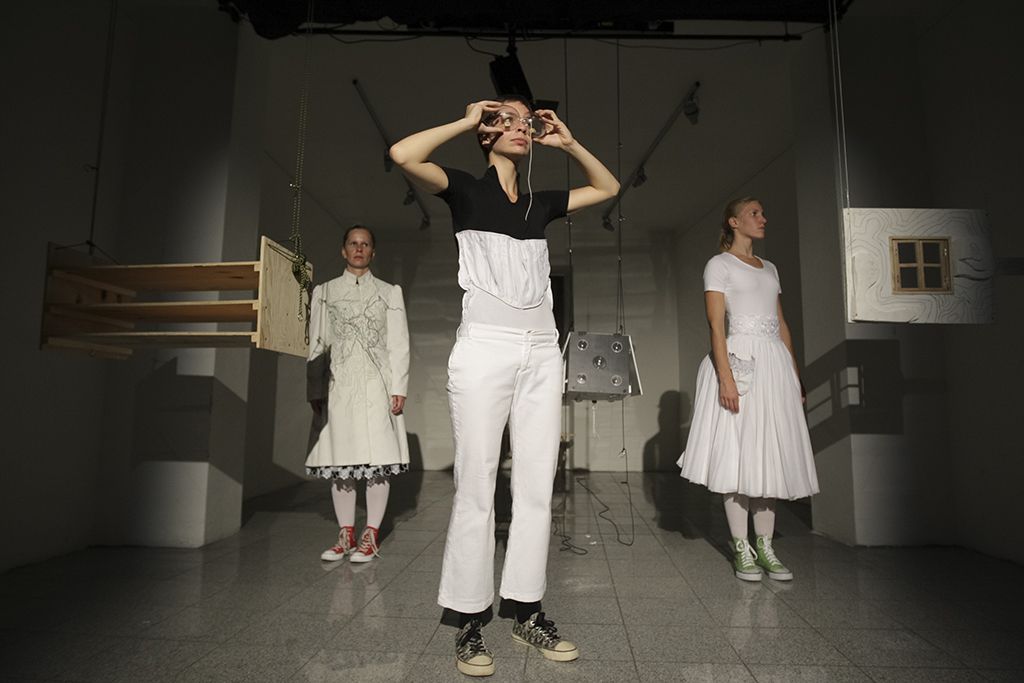
The latest production of the Non.Garde Theatre is From Marína (Od Maríny), directed by Zuzana Šimová, which was created based on the romantic poetry of the Štúr generation—Sládkovič’s famous Marína. However, Marína was merely a stepping stone; From Marína was the source of inspiration that transformed into a unique stage poetry. From Marína, the director and actresses received a gift that they decided to unwrap, savor, disassemble, and present to the audience in a new packaging. In the production From Marína, one can notice certain similarities with Štrbák’s poetics, by which Šimová, as a director, was visibly influenced. The meditative tempo-rhythm of the production, the radical rejection of an onslaught of fast and dynamic images, and a stage condensed with dense, symbolic images are in many ways reminiscent of the production The Second Round (Druhé kolo). Even the non-psychological acting of the three actresses on stage suggests that the creation process was likely similar to the production of that play. For her project, Zuzana Šimová chose, in addition to actress Dorota Letenayová, with whom she collaborates on children’s fairy tales, two non-professional actresses—Natália Bokníková and Vladislava Plančíková. What might seem like a surprising choice at first glance proves to be the correct one. Šimová was not looking for actresses who could fulfill her vision to the last detail; she was looking for partners for a dialogue, for a long, systematic, and creative journey accompanied by the character of Marína. Therefore, a viewer who expects emotional outbursts of grand acting performances in the theatre will be disappointed. I must admit that to a large extent, I also belong to this group of viewers: I like to see an actor on stage who gives their all—who sacrifices themselves for the viewer for a moment, and I do not mean a pathetic and heavy psychological experience of grand gestures. Nevertheless, this “non-acting” in From Marína was not a negative experience for me. It is clearly felt that the actresses systematically and with slow steps went through this artistic self-sacrifice long before they stepped out in front of the audience. Moreover, all three girls are very interesting on stage: they are beings full of mystery, and their gentle uncertainty leaves a warm feeling of authenticity.
The poetry of Andrej Sládkovič in the hands of four women gave Marína a chance to speak: the production is truly a sensitive probe into the female soul. Thanks to the Non.Garde Theatre, Marína is no longer merely the described subject of the poet’s desires. Three stories of Marína unfold on stage, in which each of the actresses created her own concept, narrated almost in silence—utilizing only minimalist objects and atmospheric sounds, creating a broad semantic field. A male voice in this purely female thinking and feeling is heard only through audio recordings, via selected stanzas of Marína recited by several men. The gentle pathos emanating from their words is a sort of subtle irony directed at Sládkovič’s vision of woman as a bearer of national meanings and symbols that deny her fierce individuality. In a chain of associations, the viewer pieces together their own subjective story during the production. An attempt to recount mine would likely lead me to a dangerous crossroads of telling an endless, serialized story. Furthermore, I believe that the goal of this creative team is to leave space for each viewer for their own intimate story. The staging approach brings a great freedom of perception, uncovering, and revealing, and each of the audience’s stories thus claims infallibility. For me, however, it was precisely this unlimited freedom that, paradoxically, limited me the most in this production. I missed boundaries that would hold my attention, that would guide me toward a certain way of reading these three concepts. In this manner, it felt as if I were merely catching snowflakes that melted in a split second on a warm palm. And so, brief shudders of joy from beautiful, imaginative images are overshadowed by an ultimate restlessness resulting from my own lack of understanding. I wish I were at least half as creative a partner as the uncoverers of Marína’s spirit were during their work.
In contrast to the symbol-heavy set, the final epilogue in the form of a documentary video clip acts as a very refreshing element in the production. The creation of From Marína did not end with the final performance whose fixed form is presented to the viewer. The girls decided to continue on their journey and came up with an intriguing idea on how to send out a signal about Marína into people’s awareness. By sending a wooden puppet personifying Marína—which, by the way, also functions during the performance, sitting among the audience and curiously observing the stage action with large eyes—to the inhabitants of Banská Štiavnica, who have the opportunity to live with the puppet for a week and then talk about their cohabitation on camera, the girls awaken to life not only Marína but also history. They find new parallels not only with poetry but also with theatre, which is no longer a closed form. I think Marína can be truly grateful to the girls. Who knows how Andrej Sládkovič would perceive it all?
Jana Hanzelová
The Story of the Non.Garde Theatre. In: kød – konkrétne o divadle, Vol. III, No. 10/2009, pp. 37-38.
Marína Presented by the Non.Garde Theatre Focuses on Movements and Audience Perceptions
The Non.Garde Theatre was founded in 2007 and opened its third season with the premiere of the production From Marína, based on the melodious poem by Andrej Sládkovič.
While Sládkovič’s well-known Marína is full of romantic declarations, reflections on the beauty of the Podpoľanie region, and a celebration of the vast Slovak land, the production by the Non.Garde Theatre is of a completely different nature. The theatre has chosen poetics in which it communicates with the viewer through non-verbal expressions, minimizing the word, which appears sporadically and in hints. It concentrates the power of the theatrical statement into movements that are demanding on the viewer’s perceptions. It depends on each visitor of the performance what they take away from the theatre; they cannot expect tangible evidence and exact formulations. Such is the latest Marína.
In wide skirts, a voluminous backside protrudes toward the viewer, only for its erotic function to be simultaneously humiliated by sharp punctures of metal arrows into the background. It speaks of erotics, yet her breasts remain covered. She performs domestic chores with humility and resignation, but her world takes place in entirely different dimensions.
The production From Marína is a modern-day mythology that shifts the traditional perception of a notoriously well-known story into contemporary planes. However, this is not a classic modernization of the poem, but an abstraction of Marína’s timelessness. Directed by the young theatre director Zuzana Šimová, the play features Natália Bokníková, Dorota Letenayová, and Vladislava Plančíková. The set and costumes were designed by Diana Strauszová.
The ambition of the Non.Garde Theatre is to bring together young creators of contemporary art. It offers space for genre crossovers, openness, and communication with audiences and artists who wish to express themselves freely. The creators fulfill this endeavor in their latest premiere, which they offer to audiences with imagination, the capacity to accept unconventional forms of theatrical execution, and tolerance for modern staging mindsets. The Non.Garde Theatre is located in the Central European House of Photography at Prepoštská 4. The second premiere of the production is scheduled for September 21, 2009, at 8:00 PM.
Dáša Šebanová
Bratislavské noviny, September 17, 2009, Vol. XII, No. 30/2009, p. 14.