Performance
A non-theatrical performance in which four women reveal themselves to the viewer. The materialization of a person’s secret inner rituals into space and time balances on the edge between an intimate probe into the depths of the soul and a meaningless farce.
Cast: Zuzana Šimová, Jana Šturdíková, Lucia Čarnecká, Diana Strauszová
Set design: Ján Štrbák
Costumes: Diana Strauszová
Props: Everyone
Direction: Ján Štrbák
Photos: Ctibor Bachratý, Ján Štrbák, Jana Šturdíková
Premiere: December 15 and 16, 2008



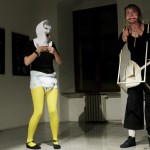

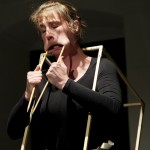
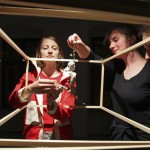
Feedback:
The Non.Garde Theatre and Its Second Round
The Non.Garde Theatre, located on the second floor of the Central European House of Photography (SEDF) gallery at Prepoštská 4, was founded in April 2007. Its latest premiere is a performance titled The Second Round (Druhé kolo).
The theatre has a capacity of 40 people, which is the approximate number of viewers that can be captivated during an evening by an almost non-theatrical mediation of the actors’ feelings and experiences on stage in the exact form they wish to offer them to the audience. All protagonists of the theatre, whether performers or creators, are professional theatre artists, and through their work, they strive to create a continuous and stimulating foundation for the emergence of new creation. Thus, in the spirit of the concept and interests of the Non.Garde Theatre, the latest premiere by the creators, titled The Second Round, offers the viewer a glimpse into the souls of four women.
The materialization of a person’s secret inner rituals into space and time balances on the edge between an intimate probe into the depths of the soul and a meaningless farce. The young girls on stage interpret their feelings and perceptions using props and sounds. Those who “happened to be passing by” might be taken aback, perhaps sometimes by a conception of reality that is immensely distant from the aesthetic perception of the average consumer.
It is good that Bratislava has a theatre of this type. And it is almost certain that every evening, 40 people will be found to sit in the auditorium of the Non.Garde Theatre. The performance The Second Round, directed by Ján Štrbák, features Z. Šimová, J. Šturdíková, L. Čarnecká, and D. Strauszová.
Dáša Šebanová
Bratislavské noviny, March 14, 2009
(Adapted from: https://www.bratislavskenoviny.sk/kultura/18462-divadlo-non-garde-a-jeho-druhe-kolo)
The Story of the Non.Garde Theatre (Excerpt)
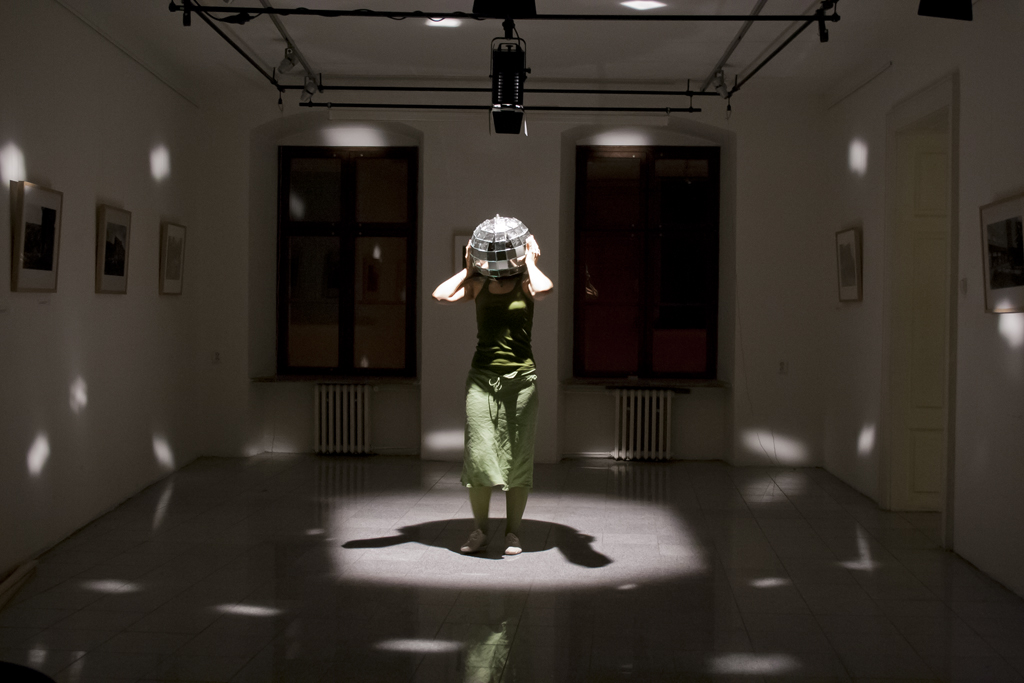
(…) We can also define the directorial work of Ján Štrbák, who rehearsed the production The Second Roundwith the theatre artists, by its intangibility and the absence of a story in the classical sense of the word. Štrbák is a calmer director, more restrained in the textual component. His text and lines consist of images full of symbols. The world he wants to capture comes from within; it is not as overexposed, it does not scream, but rather comments in silence. Through this immersion into the interior and through reflection, Štrbák is a director-philosopher. The Second Round was more disciplined in guiding its thematic line, even though the theme remained vague and mysterious to me. Using the technique of an inner probe into the female interior, Štrbák brought the lives of four women onto the stage in a sort of surrealistic form, the symbolism of which likely arose from the stories and conversations accompanying the rehearsal process. Each actress led her own story thread in segments, with one always yielding to another; the viewer had to be a truly focused observer to later piece the individual stories together. All of this took place in a kind of ritualized mist of an intimate confession that resigned itself to a shared connection. The only tangible connection, which seemed to ironize the entire production from above, was a monologue about the search for the Spirit of the Age (Zeitgeist), which eventually materialized in a disco ball. The ending was also surprising, in which all the girls found themselves, as if in a scaled-down reality, within an artificially created scenographic space that was an exact copy of the space in which the theatre had been taking place the entire time, and where all the actresses appeared as miniature figurines bearing their likenesses. Time, existence, reality—everything was thereby called into question; the theatre seemed to lose its seriousness in and of itself, reminding the audience that it is all just one big trick and a joke.
In Štrbák’s productions, we can also observe a retreat of acting expression, one could even say toward the suppression of the acting ego. The acting in the production The Second Round was more of a recapitulation of a creative path of thinking and generating, which the production itself merely recapitulates ex post. It is not that Štrbák simply placed the girls like his puppets on the stage to fulfill a formal vision; the production is a recording of a dialogue and mutual inspiration. I will use a cliché that I believe best defines this production: the journey itself can be the destination. Indeed, I have no doubt that everyone involved in the creative process—both the director and the actresses—learned a lot from each other. It must have been a truly beautiful journey that we, the audience, can only silently envy. It is a pity that the production, flooded with symbols that create a complex web, is no longer so exciting in and of itself. Allow me a brief detour. The word symbol comes from the Greek word “symbolon”—a token of recognition. In ancient Greece, when two friends parted ways, they broke a coin, a clay tablet, or a ring. When the friend or anyone from their family returned, they presented their half. If these two halves fitted together, the person in question was recognized as a friend. Based on this short insertion, I believe that a symbol in theatre should also be a kind of token of recognition. It should not be self-absorbed, but should communicate with the viewer, finding a friend in them. This, in my opinion, is the greatest problem of the production The Second Round, narcissistically concentrated on its own image. Or perhaps it is just my unwillingness to look at someone’s portrait on the surface of a theatrical lake. (…)
Jana Hanzelová
The Story of the Non.Garde Theatre. In: kød – konkrétne o divadle, Vol. III, No. 10/2009, pp. 36-37.
STATION – A Holiday Sitting in Good Company
Sign: Only for the Demanding
(Excerpt)
(…) The Bratislava-based theatre Non.Garde also continued in its trilogy of searching and contemplation, namely with its non-theatrical production The Second Round (Druhé kolo). Non-theatrical, perhaps, because one would look hard for acting techniques or movement as an artistic medium within it. We were left only to look at the overall expressive form and marvel at the abstractness, to which the performed actions and manipulation of object-props occasionally gave meaning. Everything depended on the prism through which the viewer looked at the entire production. If one was looking for the character of the „Spirit of the Age“ (Zeitgeist), a philosophical lecture on the interconnectedness of parts of all existence helped, which could be quite entertaining in an altered state of consciousness. In that case, however, there was a risk that an impatient viewer might have slipped out to a house party in the meantime, achieved enlightenment there, and returned with a disco ball instead of a head. Even though the performance might have reminded some of a sophisticated Lynchian world, there was not enough time for anyone to reflect on the symbolic and meaningful value of the images, which featured an alarm clock, a radio, balloons, toilet paper, or a wind chime. All that remained was to let oneself be carried away by the pace of contemplation over the „Spirit of the Age“ and stop expecting more than what was actually possible to see and hear… Whether the performance was meant to be—according to the playbill—an „intimate probe into the depths of the soul“ or just a „meaningless farce,“ I cannot shake the impression that director Ján Štrbák’s ambition to create something personal and original, unfortunately, „overwhelmed“ the will to extract the most personal element from the actresses—their own emotions and talent. (…)
Milan Zvada
STATION – A Holiday Sitting in Good Company. Sign: Only for the Demanding. In: kød – konkrétne o divadle, Vol. III, No. 7/2009, p. 35.