Performance
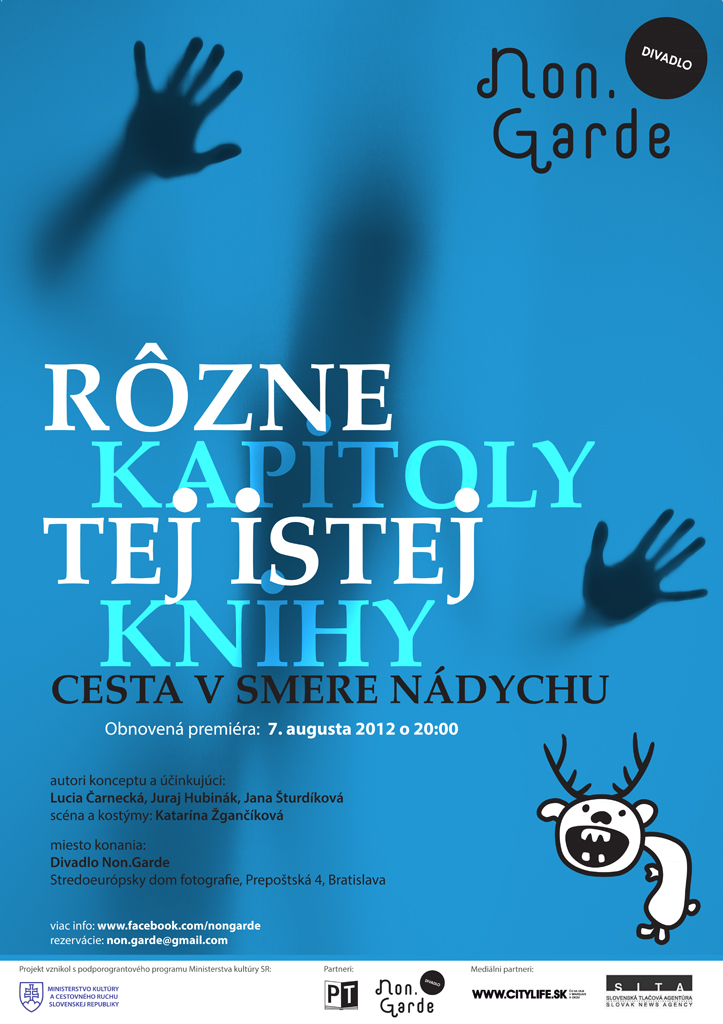
The work was created through collective creation based on a pre-selected theme. This time, it was fear, which binds a person and places hard-to-overcome boundaries within their soul. Different Chapters of the Same Book speak about a journey of determination and courage to overcome one’s own limits. They are a search for a new and free relationship with oneself and the surroundings, with which we constantly confront ourselves in life. Seriously, humorously, and wittily, they combine movement with words, visual elements, and sound. The result is an impressive journey for the viewer as well, who, if willing to embark on it, will arrive at an interesting knowledge about themselves. Visually, the production is inspired by Japanese Kabuki theatre.
Authors of the concept and performers: Lucia Čarnecká, Juraj Hubinák, Jana Šturdíková
Set and costumes: Katarína Žgančíková
Direction: authors of the concept and performers
Photo: Peter Korček
Poster: Lucia Pelikantová
Premiere: August 8, 2012


Feedback:
Small and Intense Feelings When Leafing Through a Book
In the Slovak theatre context, visual performance—and performance in general—remains on the margins, not only in terms of numbers but especially regarding the quality and originality of the artistic statement. Gradually, however, thanks to the increasingly visible achievements of Slovak artists such as Sláva Daubnerová or Debris Company, action in space is gaining clearer and more “transferable” means of expression. Projects are gaining theatricality while remaining distinctive and unique.
The Non.Garde Theatre, creating within the Central European House of Photography, has based its work on searching for a personal statement through visual objects and musical crossovers. It is precisely this personal input combined with an authentic space that Non.Garde has been working with for several years; a space, action, and acting expression strongly reinforced by the visual aspect of the project. The dramatic text, which appeared in previous projects, is gradually disappearing in the latest ones and is being replaced by action, or rather, the presence of an object in space. In their project Different Chapters of the Same Book, they once again utilize the canvas of visual performance with a strong accent on the personal experience of reality. The new production is another visually and intellectually stimulating work by a professional alternative theatre that moves on the border between visually stylized performance and a happening. In the gallery space, you can hear the sounds of the street, and every word or sound is multiplied by an echo.
On its creative journey, the Non.Garde Theatre strives to find a distinctive expressive language. It must be said that in their latest project, Different Chapters of the Same Book, they succeed. The performers work meaning-fully in silence. Playfully and poetically, their individual segments are formed by alternating deep silence, preparation for an action, and a sudden sound that falls back into silence. It is precisely the combination of sound, movement, and visual installation that creates the specific poetics of the Non.Garde Theatre. In her latest project, the aforementioned Sláva Daubnerová and Debris Company work very closely with these elements as well. Different Chapters of the Same Book discover for the audience the inner world of the performers, their life tremors, fears, and trials, while gently and very spontaneously inserting their individual stories into a free flow of narration. It is a gradual uncovering of one’s own inner self, desires, and personal world. Sharing personal feelings can be very intimate and exhausting, but also liberating and playful. It is precisely the playfulness and slight imperfection that come across as more honest and spontaneous than precisely rehearsed mise-en-scènes. Formally, the performers were inspired by the traditional Japanese theatre form Kabuki, which they adapted into the shape of a personal, even contemplative statement.
The performance unfolds into three stories of three performers, which bypass, touch, and intertwine with each other, creating a shared message. They become visual subjects, minimizing their expression, gestures, and emotions. They define their relationship to one another as their presence in space; instead of classical means of expression, they work with the position of an object in space, sound, and voice. Silence is one of the defining expressive tools in this production. The actor literally becomes an object—an item that “lives” by simply existing. They managed to incorporate elements of Kabuki theatre, such as movement and dance, into a distinctive narrative structure. All three components of this traditional form of Japanese theatre appear in the performance: dance, music, song, and stylized movement. The story can be felt intuitively, almost subliminally. It consists of fragments of personal feelings, a story of searching for solid ground within oneself, and an inner definition against the outside world.
Juraj Hubinák, in his object which I would call the Poetic Samurai, dressed in dark clothing with a hood over his head and toe shoes, becomes a seeker of certainty within himself. His attempts to walk on the tiles feel very natural. With unconcealed anxiety, he tries to aim the tip of his foot into the center of a tile and step as quietly as possible. Tiny insecurities, sometimes convoluted movements, silence, a cry, or a shudder lead to an inner dialogue with himself, but also with the other two female performers. He eventually removes the black hood or mask behind which he hides and, thus liberated, sings the final message of the story.
Jana Šturdíková appears with a white structure around her waist from which envelopes hang. Soon after, we see her wrapped in a white lantern-shaped cover that she has turned into a shelter—a refuge from the voices that pursue her at the slightest movement. It is an intimate world hidden from others, fragile in its honesty and omnipresent fear, which eventually materializes into sand, and the performer gets rid of it by pouring it into a trash bin.
Lucia Čarnecká presented a visual installation that speaks of her fears from night dreams and personal terrors. She gradually draws silhouettes of figures, discarding them one by one, and with horror finds and throws away drawings sketched beneath white drawing papers—they are apparitions of the past. Her fears are, on one hand, comical in their spontaneity, yet disturbing and persistent. One of those apparitions remains on her face, in a mask that she gradually wipes off her face.
Upon repeatedly re-entering the space, each of them searches anew for their place, orientation, and balance. For a moment, each continues what was already presented, like the refrain of a song, and follows the plot of the story further. They coordinate with other objects in space, expressing themselves, but without exhibiting. This fragile honesty, devoid of any attempt to shock or draw attention to oneself at all costs, is rare. The emotions from all three lines presented by the performers gradually converge and influence each other. They come as a result of actions in which physical expression (as we know it in actors) is minimized and suppressed to a neutral level. All three are defined by a fear of disorder, a conviction that peace comes only when objects—meaning feelings—are in their “assigned” place. The performance shows a path to achieving personal peace by overcoming the fear of new experiences. The performers complement each other, striving for synergy without stiffness or a long rehearsal process. The rehearsal process, at least according to the presented form, focused on research and searching. While Lucia Čarnecká inclines more toward visual installation, Juraj Hubinák leans toward music and movement theatre, and Jana Šturdíková toward theatre. The dramatic quality lies in a sudden movement, a sound, or an unexpected cry. In its energy, the performance resembles contemplation during prayer or meditation.
For a theatre based on an object that feels almost like a gallery exhibit, a visual sensitivity is very important. The costumes and set by Katarína Žgančíková were evidently created in close contact with the performers. The objects do not merely complete the scenes but, above all, determine their overall tone and meaning. The action is connected with manipulating them. Fragments of individual scenes gradually fill with meaning, which, however, is not as important as the emotion.
The musical component consists of sounds within the space interacting with the manipulation of the costume, the performer’s movement, or their voice.
Different Chapters of the Same Book are different forms of personal fears and insecurities, a search for balance and a firmer point. It is a fragile world of animated objects struggling with their existence, while writing a poetic record—a poem—from this journey. The Non.Garde performers give the audience an opportunity to peer into their personal world, yet they do not cross this personal distance, leaving room for perspective and irony. The chapters, as different situations, write the same book, from which, after reading it, the capacity to empathize with oneself transfers to the viewer themselves.
Marek Godovič
The review is part of the Project Monitoring of Theatres in Slovakia, which is an activity of the Slovak Centre AICT (International Association of Theatre Critics).
The partners of the project are the Theatre Institute and the Theatre Faculty of the Academy of Performing Arts. Realized with the support of the Ministry of Culture of the Slovak Republic. (Adapted from: https://monitoringdivadiel.sk/male-a-intenzivne-pocity-pri-listovani-jednej-knihy/)
On the Non.Garde Theatre and Different Chapters of the Same Book
The Non.Garde Theatre, which has been operating since 2007 on the premises of the Central European House of Photography in Bratislava, by no means represents traditional theatre. It eludes not only the notion of a narrative theatrical performance with rehearsed acting roles based on a prepared literary libretto, but also many theatrical conventions and genres. The more Non.Garde diverges from theatre, the closer it approaches and intertwines with certain modes of contemporary visual art, particularly performance art. It is well known that performance is a kind of common denominator between theatre and visual art: since the times of Futurist, Dadaist, Surrealist art, or post-war action art, Fluxus, and later body art, it has taken on many forms up to the most current ones in contemporary art. However, the essence of performance lies primarily in the principle of ritual, which takes place in real-time and involves an interaction between the performer and the participant of the ritual/viewer.
The performers of Non.Garde thoroughly master the ritualistic nature of both theatre and performance art. Their performances can be understood as a series of individual performances that stem from a shared concept but are further left to the self-expression of the performers with their very specific themes, gestures, props, and costumes. In addition to the work with the body itself, a unique element of their performances is also that they do not take place on a stage, but within an exhibition space, which they not only accept but appropriate or comment upon. Thus, an exhibition of black-and-white photographs or the exhibition space itself (from floor to ceiling) becomes the subject of reflection. It can be said that such performances are ‘site-specific’ (animated) installations that play out a whole series of mutual references between the worlds of theatre and exhibition. The visuality of Non.Garde’s performances is their dominant component: part of the performances is color-reduced, while elsewhere, they work significantly with darkness and light. Spoken texts/monologues and sounds, or music, are suppressed to a minimum. It can be said that each performance is a series of ephemeral images, where ephemerality is often underscored by props or rather objects that are discarded, torn, or otherwise destroyed during the performance. However, the process of using, removing, or destroying – mostly paper objects – is not an end in itself; it is always related to the micro-stories presented by the individual performers. It is also characteristic of Non.Garde that not only the texts, but also all costumes and props/objects used in the performance are original creations. However, many of them vanish after the performance, as is typical in process art, which counts on impermanence and transience from the very beginning and actually problematizes the issue of time, origin, and demise. The Non.Garde team takes many of these phenomena into account: instability, ingenuity, as well as witty allusions and parodies of serious Art are among their favorite working methods. Breaking down stereotypical ideas about individual art forms and expanding their possibilities is liberating and entertaining not only for the performers themselves.
doc. Mgr. Mária Orišková, Dr. phil.
Art theorist