Performance
An original chamber-scale stage collage of humorous theatrical vignettes in a wide variety of genres and styles, on the theme of human communication, loneliness, and the search for identity.
Cast: Laco Kerata, Dora Letenajová, Diana Strauszová, Zuzana Šimová, Jana Šturdíková
Set and costumes: Diana Strauszová
Sounds: Everyone
Direction: Laco Kerata
Photos: Jana Šturdíková
Bulletin: Diana Strauszová
Premiere: February 25, 2008

Feedback:
Laughter Through Tears, Tears Through Laughter…
The production Extempore is the result of the creative team of the Borba Theatre, which opened its 2008/2009 season under the new name Non.Garde. It is a professional theatre located in the center of Bratislava, forming a part of the multifunctional space of the Central European House of Photography. It connects contemporary creators, establishes a continuous and stimulating foundation for the emergence of new creation, and provides a platform for pushing boundaries and achieving genre crossovers. It offers a space for openness, communicativeness, and interactivity toward audiences and artists who wish to express themselves freely. The guarantor and director of most projects is the author, director, and actor Laco Kerata. The permanent members are actress and director Zuzana Šimová, director and dramaturge Jana Šturdíková, set designer Diana Strauszová, and manager Lucia Čarnecká.
On Friday, October 24, 2008, the MED association presented, as its 8th premiere, the original theatrical performance Laco Kerata and Collective: EXTEMPORE—an intimate stage collage of humorous theatrical treats of various genres and styles on the theme of human communication, loneliness, and the search for identity.
In reality, however, much more occurred on that evening than a mere presentation of original texts. Through the means of contact theatre, Zuzana Šimová, Jana Šturdíková, Dora Letenajová, Diana Strauszová, and Laco Kerata touched all the audience members present, managing to showcase a vast and colorful spectrum of sad, joyful, absurd, unusual, unexpected, or completely normal situations within a small space. They succeeded in making the viewer laugh, moving them to emotion, and forcing them to pause for a moment and reflect on things that are entirely common yet abnormal. In eleven short sketches, they pointed out the classic problems of today, creating a unique atmosphere with the help of music, background noises, and sounds. The actors literally filled the stage with themselves, as they were the props.
Contact theatre has the advantage that the audience is allowed to look at the actors from a very close distance, thus sharing all emotions with them and perceiving the utilized tools more intensely, which are so highly effective, authentic, and powerful.
Since the actors were also the authors of the texts, they performed the ideas and lines exactly as they had written them, with a dose of genuine emotion and an unmistakable feeling. Intonations were placed precisely where the author felt them, and every pause or ellipsis resonated exactly where it was supposed to.
The title of the production is therefore apt, as we know an extempore as an utterance or remark made without preparation, an actor’s own addition to the text of the play.
The viewer enters a small, intimate space with an auditorium capacity of approximately 30 seats, perceiving the atmosphere created by a small audience. The dialogues of older ladies about a Friday massage—for instance, how under a new law a massage chair will no longer be a massage chair unless it receives a medical device certificate—or about a new manicure, foreshadow a lack of understanding and perhaps a slight confusion in grasping the work. The production Extempore, similar to others from this theatre’s repertoire, requires a viewer capable of accepting and appreciating a specific poetics of an avant-garde character.
Black velvet curtains, a single light at the back of the stage, two chairs on set, with a small black backpack between them… thirty chairs in the auditorium… a gentle murmur from the audience… and I absorb the relaxed atmosphere, which does not change with the arrival of the actors… both before and after the performance, a good feeling remains, a feeling of humanity…
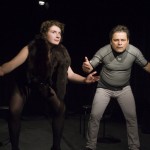
THE THINKING (MYSLENIE) of Zuzana Šimová and Jana Šturdíková represents a dialogue of a philosophical nature, consisting of wordplay between the two. They sit on chairs wearing white tank tops, lace rompers, black nylons, and high heels. On their heads are black ushankas, and in their hands are small glasses. At times, the performers draw closer to one another, as if hinting at an erotic intimacy through subtle gestures, only for alienation and coldness to arrive in a fraction of a second. Distinct facial expressions form part of it. The black-and-white costumes express opposites, both in communication and in the characters of the actresses. At times, the text resembles the theatre of the absurd, where the content is not as important as the form and the manner in which it is presented. Zuzana appears dominant in her physical presence compared to the fragile Jana, yet a moment of closeness between them occurs…
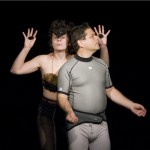
THE NOBLEMEN (ŠĽACHTICI), based on a text by Laco Kerata, represents a combination of a miniature, ballet-like dance performance by Dorota Letenajová and a verbal confrontation about the aristocratic class with Laco Kerata. Kerata portrays an unidentifiable figure in a gray, tight-fitting costume, wearing a red satin cap with pearls on his head, with an absent, nervous look on his face and a twitch of trembling hands, as if searching in the dark for answers to complicated questions for which no clear, true answer exists. The main feature of the rapid dialogue between the dancing ballerina in a tight white costume—with accessories on her chest and groin area made of the same fabric as her partner’s cap—is once again wordplay, unconventional word combinations, and a humorous character. At times, however, the essence escapes precisely due to the speed with which the actors conduct the dialogue. The visual side of the sketch is so powerful that it outweighs the content, which is a pity.
The title of the next text, THE CHICKS (PIPUĽKY), reveals that it is a conversation between two “chicks, birds, girls”—as we call them today—simply girls who care about their appearance far more than about what they have inside. Actresses Zuzana Šimová and Dorota Letenajová, in a short dialogue about vests, coats, boys, and last night, presented a sharp opinion on such girls. They handled the affected gestures and sharp expressions charmingly, intelligently executing a critique of the girls who swarm not only the streets of Bratislava.
THE PLUS (PLUSKO), as an internal philosophical postulate of Zuzana Šimová, ponders human existence all the way to the universe through an unconventional chain of associations, quite literally. She remains on stage after the previous Chicks sketch and effectively utilizes a prop she played with during the dialogue with Chick number two. I appreciate the smooth transition between these two scenes; it drew the viewer in and gently guided them into the fourth of the eleven chambers. The intentional, “unfeminine” movements and the simulated surprise on the actress’s face over her own findings appeared very comical.
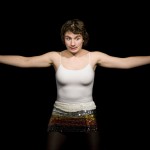
When characterizing the presentation of the text titled THE ASSISTANT (ASISTENTKA), allow me to point out a fact that has unfortunately become a commonplace today and sounds almost like a cliché. We live in an age where communication is losing its original function, and paradoxically, despite the hyper-fast development of communication channels of any nature, we have forgotten how to answer fundamental questions. Jana Šturdíková, in the role of a personal assistant programmed to answer only questions concerning the company she works for, confirms my words. A simple white costume, with a white light on her chest functioning as an indicator light signaling that the lady is ready to answer questions and is “online,” captures the character’s nature and the main idea of the text. Laco Kerata, in the role of a customer, asks elementary questions for which, however, no answer exists. From a neutral person, he suddenly turns into an aggressive individual who initially only wanted to buy simple pipes… the character of the assistant in this specific portrayal appears very harmonious and orderly; her stylized, even forced smile, which seems to have become a permanent feature of her face, does not disappear even when an unknown man threatens her and his behavior is explicitly offensive. This simple short sketch attacks the corners of the audience’s mouths once again, stretching them into a wide smile. The actors’ expressions are verbally clean, never stepping out of character for a single moment, and through a swift exchange of lines, they force the viewer to pause over the paradox of the mode of existence that is normal for each of us today. The audience is laughing, but they should be crying.
MONOTONOUS SOUND (MONOTÓNNY ZVUK) is about well-known manipulation, wordplay controlled today by financial advisors and dealers, the loss of one’s own opinion, and the voluntary choice of one’s own minority position. The duo of Zuzana Šimová, portraying a woman from Russia with a thick accent, and Laco Kerata draw the audience into an outwardly nonsensical conversation. Through a gradual escalation of sounds, movement, facial expressions, and gestures, they achieve an explosion that occurs in anyone who has been manipulated, talked into something, and then laughed at straight to their face.
ARE YOU ANGRY? (HNEVÁŠ SA?) A vital question, the occurrence of which in a conversation between partners often triggers a verbal battle, a subtle lie, or the resolution of a problem. The husband and wife, portrayed by Jana Šturdíková and Laco Kerata, present a classic conversation between partners—an argument, yet with unusual problems. This is another scene that wittily points to reality, and yet looking at it without remorse and an internal confession was simply impossible.
What is more? Zero or one? Which one holds a more important position? Which would miss the other if it did not exist? Which came first? What happens if one of them disappears? An exchange of opinions on the truth about 1 and 0 takes place between Zuzana Šimová and Dorota Letenajová. They stand opposite each other, with an elastic band wrapped around their legs through which the question—Jana Šturdíková—jumps, until they vanish into the darkness without resolving their verbal dispute.
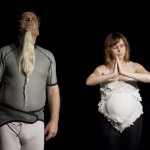
The text by Jana Šturdíková and Diana Strauszová titled THE MASTER (MAJSTER) speaks about the cult of the stronger, the influence of power, or the modern-day phenomenon of skinny ladies who are supposedly the most beautiful, as well as the conditions for advancing to higher positions or simply gaining membership in a dance group. It addresses animosity, competition, impossible demands, and the necessity to humiliate and deny oneself to achieve higher goals. The scene features a quartet of young actresses in tight white leotards and Laco Kerata in the role of the master with a long white beard. An inseparable component is, once again, a sense of humor, excellent artistic performances, and the depiction of a harsh reality.
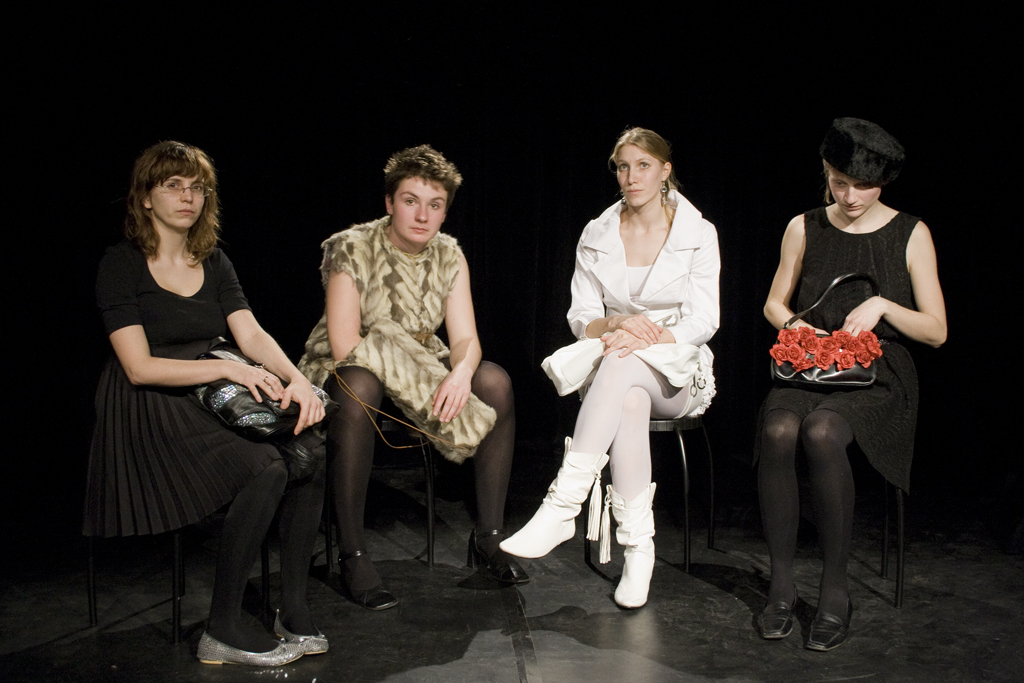
We have already seen them all, and now they meet in the penultimate part of the production. The rough woman with a Russian accent played by Zuzana Šimová, the money-grubbing “Chick” played by Dorota Letenajová in white, the modest and subservient Diana Strauszová in an inconspicuous black dress, and the fresh murderer of her husband, Jana Šturdíková, in a black beret and a black dress. A quartet of women, absolutely distinct in type and well known from the previous scenes, gather for a feministically oriented meeting where they exchange the latest stories from their private lives. They act like comic book characters, each with her typical demeanor, clothing, expression, movements, and a specific attitude toward life as well as its meaning. Each of the actresses precisely crafted a unique character and evoked salvos of laughter among the audience.
The actresses from the previous scene remain on stage to present the final part of their performance to the audience, titled SONG (SPEV). It might have caused outrage for many, as the devout-looking actresses sang a choral-style song full of vulgarities, essentially about nothing. Through their expression, words, and manner of singing, they very openly expressed their bold opinion on today’s church and especially the attitudes of believers.
On Friday, October 24, 2008, the audience witnessed an extraordinary production that directly or indirectly pointed out current moral issues, communication problems, and the absurdity of today’s lifestyle in a very humorous way… forcing everyone present to stop for a moment, think, and ultimately decide whether the way we live and behave is a matter of laughter through tears, or tears through laughter…
Magdaléna Ivanová
Theatre Monitoring (a project of the Theatre Institute Bratislava), February 25, 2008
(Adapted from: https://monitoringdivadiel.sk/smiech-cez-slzy-slzy-cez-smiech/)