Performance
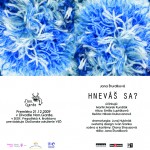
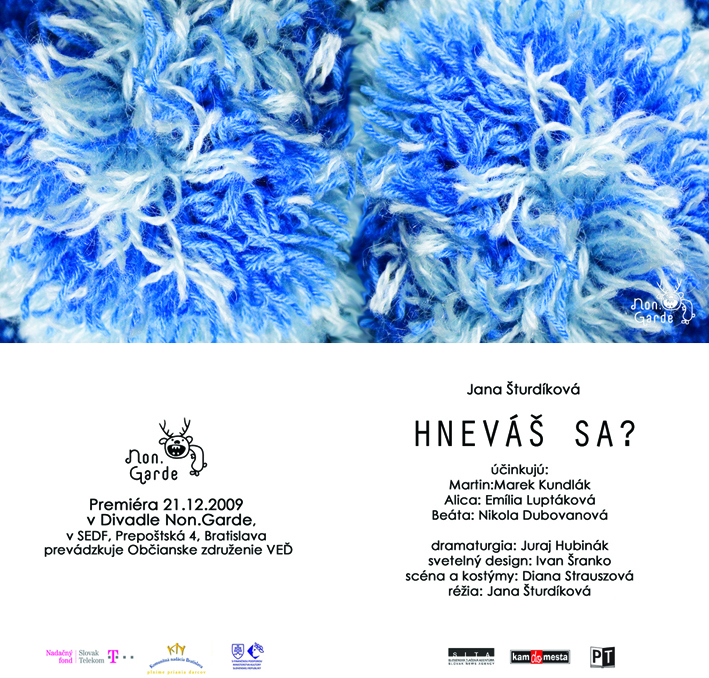 A play about three people and great anger.
Author: Jana Šturdíková
Cast: Marek Kundlák, Emília Luptáková (Mila Dromovich), Nikola Dubovanová
Set and Costume Design: Diana Strauszová
Dramaturgy: Juraj Hubinák
Director: Jana Šturdíková
Photography: Jana Šturdíková, Martin Meľo
Programme: Jana Šturdíková
Premiere: December 21, 2009



Feedback:
No, I Am Not Angry…
Non.Garde is a theatre as peculiar as its name. It consists of a few square meters in the Central European House of Photography in Bratislava and a few personalities—led by Academy of Performing Arts (VŠMU) graduates Zuzana Šimová and Jana Šturdíková.
While the former creates highly visual productions with a touch of feminine, emotional philosophy, Jana Šturdíková leans toward a more classical theatrical language. It is as if each of them, though very distantly, builds upon the poetics of one of the creators who have collaborated with the Non.Garde Theatre—Ján Štrbák and Laco Kerata.
Whereas Zuzana Šimová experiments significantly with dramaturgy, Jana Šturdíková has thematically followed up on her successful production Vťahy (a monodrama based on Erlend Loe’s novel Doppler, starring Zuzana Šimová). This time, she staged her own play titled Are You Angry? (Hneváš sa?). Once again, it addresses the theme of male-female relationships and “entanglements.” The main protagonist drags an extra woman into his married life…
The author has enriched this relationship triangle of a man between two women with two children. One who is already in the world, and another who is still developing (safe in the mother’s womb). This motif seems to underscore the distinctiveness of the two women. The wife, who has already borne fruit and whose time as a blossom is long gone, and the mistress—a blossom on whom it is only subtly beginning to show that she will bear fruit.
Šturdíková’s text possesses a unique poetic quality. Through short, almost banal sentences, the author shapes dramatic tension. Their repetition forms the framework of the story—the absurdity and helplessness of a married couple whose life now consists solely of mundane rituals. An innocent remark, the title, and the motto of the entire play („Are you angry?“) brings conflict instead of reconciliation. Šturdíková’s text and production are full of contrasts and paradoxes.
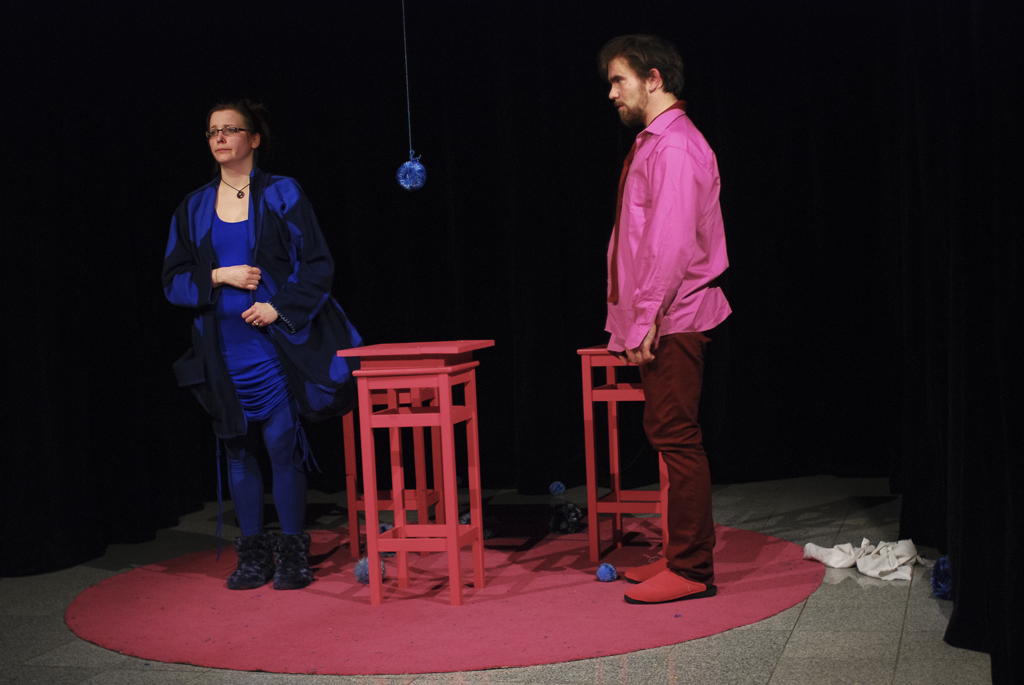
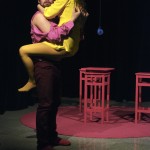
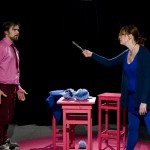
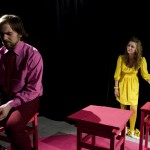
The excellent visual design by Diana Strauszová—simple and precise—emphasizes the differences and divisions between the worlds of the three main characters. Acting as both set and costume designer, she distinguishes the individual characters and their worlds not only through striking colors but also through materials. The man’s world is salmon-colored, the wife’s is blue and soft (woolen and made of pompoms), and the mistress’s is yellow and shiny (like her raincoat or patent leather shoes). Although pink or salmon was the dominant color, it was at times covered with the blue pompoms of the loving wife, and at other times pierced by the bright yellow color of the young mistress. In a certain sense, one could speak of action scenography. Covering a blue chair with a yellow raincoat, a salmon table with a yellow tablecloth, packing away the blue pompoms and the blue rug… The scenography articulated the unspoken. It confirmed the viewer’s intuition and generated new meanings.
However, the “pompom snowman” could be considered the visual symbol of the entire production. It seems to concentrate the fundamental principle of Šturdíková’s text and production—meaninglessness, contrast, and paradox.
On one hand, the modest scenographic solution (practically only a table and two uncomfortable high chairs are on stage), and on the other hand, a thorough and precise dramaturgical line provided the actors with plenty of space as well as anchor points.
The exceptionally well-chosen and synchronized acting trio managed to beautifully sense the right measure of exaggeration and discover appropriate theatrical means for their characters.
Alice, portrayed by Emília Luptáková, was immensely human, loving, and capable of sacrifice. With her pained expression from behind her glasses and her hands, which were constantly fidgeting with something, she expressed a strenuous effort to resolve the problem. She was “soft” like the pompoms that surrounded her and that she wore. Among the peak and most comical scenes was the moment when she, heavily bundled up, meets her almost naked husband. Too much desire and too much fear, the inability to truly touch him… she managed to concentrate all of this into an „almost touch“ of the naked body. Her character was dominated by the principle of giving, adapting, and focusing on others…
With Beáta (Nikola Dubovanová), it was quite the opposite. She was full of courage, unable to “detach” herself from her partner, wanting to adapt—not herself, but everything to herself. While the gestures of Luptáková’s Alice were small, trembling, and uncertain, the gestures of Dubovanová’s Beáta were absolutely confident, appropriately stylized, and capriciously childish.
Marek Kundlák as Martin—the man moving between them—did not have an easy task at all. He had to master an entire spectrum of male types—from a henpecked husband to a seductive macho—all while respecting the “real” character of his role, a sort of „likeable awkwardness.“ There were many interesting moments in his performance, but undoubtedly one of the most beautiful was the moment when his wife destroyed the „pompom snowman“ and he could not stop her. It was as if she had “cut him off” along with the pompom. She liberated herself, she escaped.
The greatest advantage of Šturdíková’s production is its absolutely precise and meticulous directorial-dramaturgical concept. The individual components of this intimate stage work complement each other, providing the viewer with a legible—yet far from simplistic—image. The viewer, much like the actor in this production, has enough solid ground not to get lost in the vast waters of an endless number of possible interpretations, but simultaneously possesses enough space to discover references and form images in their own imagination.
The Non.Garde Theatre succeeded in creating a production that is an example of mastered theatrical craft, yet imbued with charm, wit, and artistic value.
The question of whether to preserve a new life points toward a solution in favor of life. The question of whether to preserve the marriage points toward preserving the marriage… And although the ending of the story remains open, this very direction is unusual and refreshing for young creators.
The production Are You Angry? says that situations will come in life that we do not know how to solve and that will repeat endlessly—until we take responsibility for our actions… Until we do so, we can be angry—just like Šturdíková’s protagonist—only at ourselves. No, I am not angry; this theatrical experience was delightful.
Zdenka Pašuthová – Marková
Theatre Monitoring (a project of the Theatre Institute Bratislava), December 21, 2009
(Adapted from: https://monitoringdivadiel.sk/nie-nehnevam-sa/)